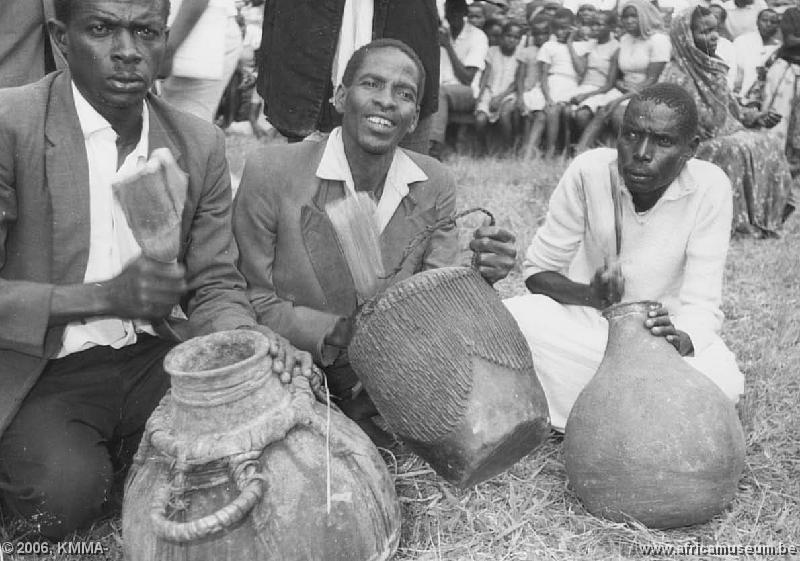

The percussion pot is a utensil that is used as a musical instrument. It is a large earthenware pot with a short neck and a broad opening with edges that are curved slightly outwards. It is normally used to hold beer but also can serve as a rhythm instrument. Generally the pot has a height of between 30 and 40 cm and a breadth of 35 cm. A rope with a loop is tied around the neck of the pot for carrying purposes. In the production of a percussion pot, clay is mixed with broken potshards to ensure that the clay does not burst while baking.
When the pot is turned, it dries for a few days and is afterwards baked in fire. No further decoration or drawings are applied.
The percussion pot is played by men and women who either squat beside the vessel or stand with the vessel held under their arm. The sound is produced by striking the opening of the pot with a fan-shaped beater made from banana fibres. The percussion pot is played without fluids added to change the pitch. Previously the percussion pot was also played by women who stretched pieces of animal skin over it to form a membrane. In this case the percussion pot worked primarily as a resonator.
This type of instrument is used in recordings of our sound archives made with the Congolese peoples mentioned hereafter where it appears with the following vernacular names:
Ikole (Boyela), Kebe (Gbandi), Menda (Mongo), Nyingo (Gbandi)
Discography:
© KMMA