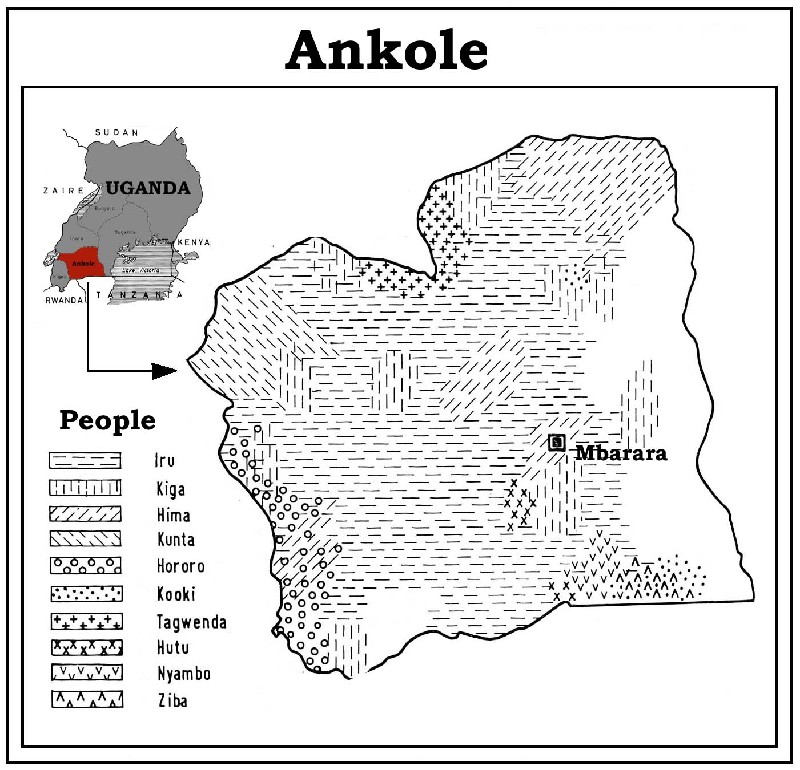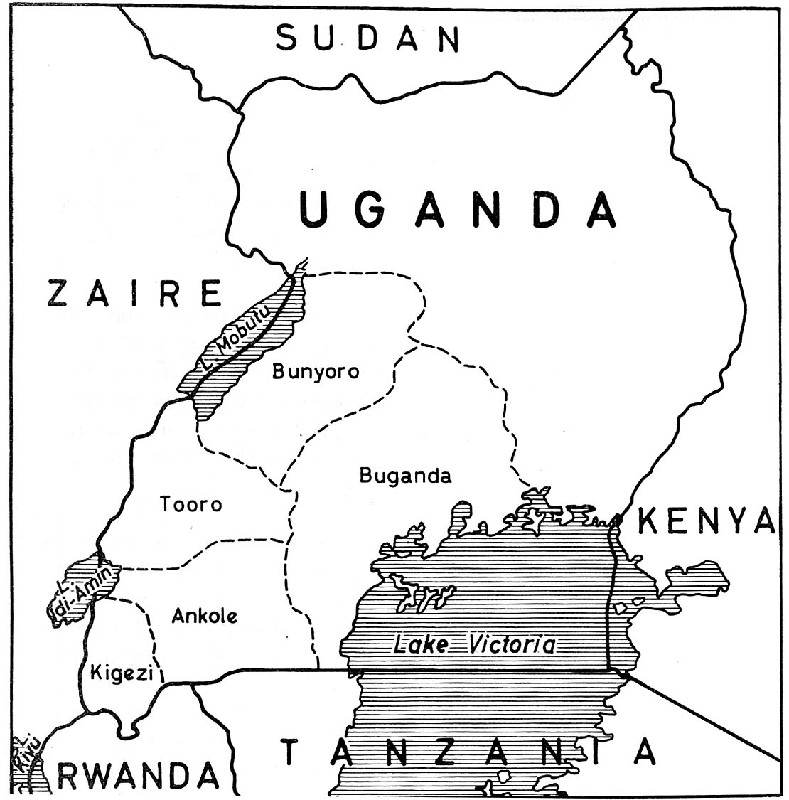
Ankole is a relatively small district in West Uganda. It lies just south of the Equator and comprises an area of approximately 16,247 km2.
Due to its altitude, the Ankole plateau landscape has a pleasant climate. The water supply
is adequate, thanks to the tropical rainfall; it has a fertile agricultural acreage, as
well as suitable pastureland. Apart from the pastoralism of the Hima, the economic structure
of the Ankole inhabitants is based mainly on agriculture, although mixed economy is by no
means unknown, that is to say agriculture combined with stockbreeding and locally also with
fishing. Industry is almost non-existent and in trade, which up to now has been chiefly in
the hands of Indians, the Africans are still relegated to an insignificant and subordinate role.
The overall picture of folk music in Ankole has undergone a gradual and interesting change.
This development can be explained, to a considerable extent, by ethno-historical data. Over
several centuries, a great variety of ethnic groups
settled in Ankole. As a result of these migrations, which were of divergent nature and extent,
the current population of the present District of Ankole is estimated at about 855,000, and
consists of Iru, Hima, Kunta, Kooki, Ziba, Nyambo, Hutu, and Kiga. Tutsi refugees have also
been living there since the recent revolution in Rwanda.
These immigrants, with their differing cultural backgrounds, have given folk music in Ankole
a richer image. In their tribal relations and family environment they retain their own customs
and habits, and thus the main elements of their respective music cultures have been preserved.
The existence of various concurring characteristic features of the musical traditions of each
ethnic group results in an interesting variety of folk music.
It is interesting to note, first of all, that the folk music of the African tribes is generally
based on several homogeneous principles. In Ankole too there exists a striking relationship
between the musical traditions of the various population groups living there.
Folk music is predominantly vocal. What stands out in the vocal music of the Hima is that
the melody often comes to the foreground more than the rhythm. The responsorial singing
between soloist and chorus is the most common singing technique among all the inhabitants
of Ankole, while antiphonal singing between two choirs is non-existent. Singing in unison
without solo occurs in many a children's song. In sung fables too, the actual tale is
frequently alternated attractively by short passages sung together in unison, ebitongyerero.
With the exception of the Hima, all the cultural groups living in Ankole belong to the Bantu.
Their respective languages are tonal. Since the tonality of the various Bantu languages spoken
in Ankole is clearly weaker than elsewhere, far less accuracy is to be found between the
melodic line of the music and the tone of the song text. Furthermore, the quantity of the
vowels is often crushed by the combination with notes of differing length. The fascinating
narrative style and the sometimes very slightly varied recital of the sung fables betray the
exceptional flexibility of these tone recitations. In order to be able to determine the degree
to which this flexibility extends, a more profound linguistic and musicological investigation
is necessary. In this respect, it should be noted that the Hima shepherds, who thus do not
belong to the original Bantu, have nevertheless adopted the Bantu language of the Iru in the
course of time, but not their music. Whereas language and music naturally influence each other,
the influence of the Hima traditional music has apparently prevailed over the tone language
of the Iru. Fascinating melismatic adornments, consisting of an interesting variety of microtones,
also typify the Hima vocal music
 .
.
A sudden and quite unprepared change in the pitch characterizes the dance songs of most ethnic
groups in Ankole. The dynamics are also affected by this change in pitch, and the raising of
the melody often goes hand in hand with an increase in volume. We only noted raising of the
pitch in the vocal music of Ankole
.
In instrumental music, particularly omubanda pipe music,
raising the pitch is accompanied by lowering the pitch on an equal scale.
Part-singing appears to play a less important role in the vocal music of Ankole than in the
folk music of other African peoples. Singing in thirds, fourths, or fifths is completely
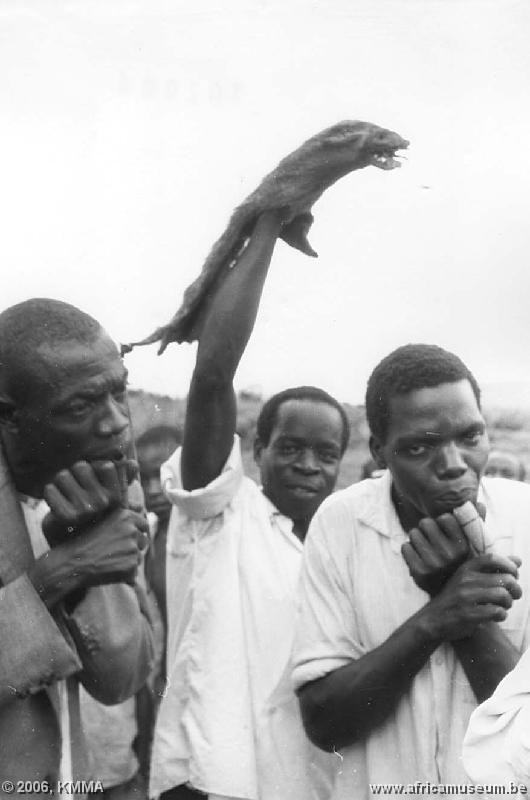 unknown. On the other hand, overlapping of solo and choir is frequent. Three-part music
formerly existed, however, in the instrumental court music of the former kingdom of Ankole,
namely in the music of the amakondere horn
group of the ensheegu pipers and the
endere flute ensemble. The music of these three court
orchestras was always performed in hoketus style. The Africans have so far not made it
clear whether this concerns a predominantly vertical or horizontal line of harmony in
this court music. According to African informants, it is quite another matter in the
endingiri fiddle music of the Ziba and Nyambo,
in which two endingiri are played at the same time, the counterpoint movements
of each endingiri pointing clearly to a vertical line
.
unknown. On the other hand, overlapping of solo and choir is frequent. Three-part music
formerly existed, however, in the instrumental court music of the former kingdom of Ankole,
namely in the music of the amakondere horn
group of the ensheegu pipers and the
endere flute ensemble. The music of these three court
orchestras was always performed in hoketus style. The Africans have so far not made it
clear whether this concerns a predominantly vertical or horizontal line of harmony in
this court music. According to African informants, it is quite another matter in the
endingiri fiddle music of the Ziba and Nyambo,
in which two endingiri are played at the same time, the counterpoint movements
of each endingiri pointing clearly to a vertical line
.
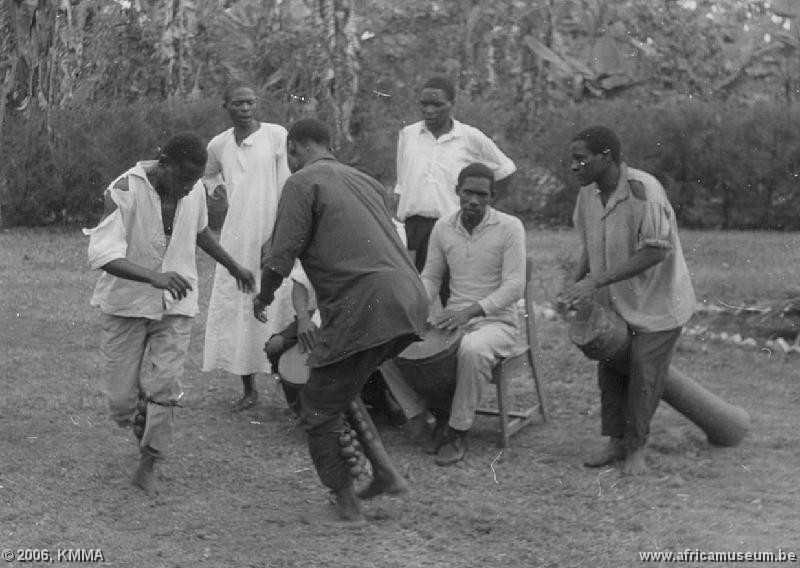 Rhythmic patterns vary from one instrument to another, from tribe to tribe, and from
occasion to occasion. The dance music of the Iru and Kiga, which is always accompanied
by uninterrupted regular drumbeats, contrasts strongly with the attractively improvised
engoma rhythm, which is found in the dance music of the Ziba
.
Special drum rhythms characterize the Iru and Nyambo songs in honour of the emandwa spirits
.
Experienced drummers of the Kunta know how to effectively produce variants on the rhythmic
underlying pattern of the ekizina dance music
.
Rhythmic patterns vary from one instrument to another, from tribe to tribe, and from
occasion to occasion. The dance music of the Iru and Kiga, which is always accompanied
by uninterrupted regular drumbeats, contrasts strongly with the attractively improvised
engoma rhythm, which is found in the dance music of the Ziba
.
Special drum rhythms characterize the Iru and Nyambo songs in honour of the emandwa spirits
.
Experienced drummers of the Kunta know how to effectively produce variants on the rhythmic
underlying pattern of the ekizina dance music
.
Nowhere in Ankole is the engoma tuned, although it should be
noted that the drums that are present occasionally produce a completely different pitch, such
as in the dance music of the Ziba
.
A cappella song characterizes the vocal music of the Hima
.
A few shepherds' songs accompanied by the omubanda flute
,
together with their zither songs
,
are an exception. The vocal music of the remaining ethnic groups in Ankole is mostly accompanied
by instruments.
A changing of the soloist during one and the same dance song occurs in the dance music
of the Kunta and Iru.
The repertoire of the Hima, unlike that of the other inhabitants of Ankole, consists of
panegyrics in honour of their cattle, which comprise the fundamental standard of all Hima
values. Furthermore, they sing frequently in praise of the universe, the heavenly bodies,
the pastures, and the rain. In the past, their sovereigns and members of the royal family
were often the subject of their songs of praise. Today they extol their own family members
.
Various cultural groups have their specific song styles. During their dance songs,
the Kiga and Kunta women often express their joy by producing "ololyges". The
ekitaaguriro dance performed by the Iru men is frequently characterized by a
typical choir style
.
Hima songs in honour of the spirits (emandwa) are characterized by an exceptional
style of yodelling
.
The song style of the Hima women during the enanga zither music
differs greatly from that of the Kiga
.
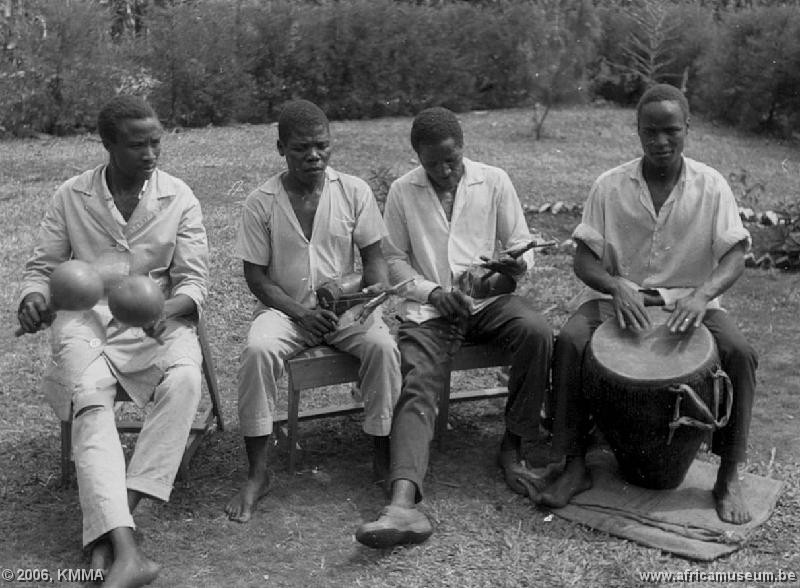
 When playing certain musical instruments the various ethnic groups in Ankole also apply a
completely different playing technique. The cylindrical engarabi drum
is also played by the Kooki with their hands and never with drumsticks. The manner in which
the conical engoma drum is played, however, varies from
tribe to tribe. The Iru and the Kiga use one drumstick, whereas the Kooki and the Kunta
play the engoma only with their hands. The Ziba men quite often play two engoma simultaneously.
When playing certain musical instruments the various ethnic groups in Ankole also apply a
completely different playing technique. The cylindrical engarabi drum
is also played by the Kooki with their hands and never with drumsticks. The manner in which
the conical engoma drum is played, however, varies from
tribe to tribe. The Iru and the Kiga use one drumstick, whereas the Kooki and the Kunta
play the engoma only with their hands. The Ziba men quite often play two engoma simultaneously.
Once a dance song is under way, the difference noted in the tone volume is generally nil or
only slight in Ankole folk music. However, with the Kiga, sudden and entirely unrehearsed
changes in the drumbeat rhythm and an intensification of the handclapping occur in one and
the same dance song. This frequently results in a fascinatingly dynamic contrast.
In the musical life of the various groups of inhabitants in Ankole an important part is
played by some of the solo instruments, such as the omubanda
and ekinimba flutes, the
umunahi or egobore musical bow with a fixed gourd
resonance box, the endingiri one-string fiddle,
the ekidongo three-string musical bow, and especially
the enanga board zither.
 The 6-7 stringed enanga has been encountered so far in
Ankole only with the Hima and Kiga. The tuning of the instrument, the tone material, the
melody structure of the song as well as the melodic patterns of the accompanying zither of
the Hima women differ considerably from those of the Kiga men. Both the Hima and the Kiga
performers pluck the string with both hands, always open and never closed.
The 6-7 stringed enanga has been encountered so far in
Ankole only with the Hima and Kiga. The tuning of the instrument, the tone material, the
melody structure of the song as well as the melodic patterns of the accompanying zither of
the Hima women differ considerably from those of the Kiga men. Both the Hima and the Kiga
performers pluck the string with both hands, always open and never closed.
The music of the omubanda flute cannot be distinguished
from the ekitaaguriro dance music of the Iru
,
while shepherds' songs of the Hima are sometimes rendered with omubanda flute music
.
The ekinimba flute music of the Kiga is usually heard during
the rendering of their epic poems
.
 As regards the music of the one-string struck instrument, the endingiri,
the usual method consists of the solo performance of the endingiri player who
accompanies himself. The harmonizing of several endingiri, each playing their
specific part
,
and the presence of rhythmically accompanying musical instruments such as the drum and handclapping
or box-shaped cane rattles
vary from region to region.
As regards the music of the one-string struck instrument, the endingiri,
the usual method consists of the solo performance of the endingiri player who
accompanies himself. The harmonizing of several endingiri, each playing their
specific part
,
and the presence of rhythmically accompanying musical instruments such as the drum and handclapping
or box-shaped cane rattles
vary from region to region.
The musical bow with three strings, the ekidongo, is found
only with the Nyambo. To play it, the performer uses a plectrum
.
The one-string musical bow with a fixed gourd resonance box,
called egobore by the Nyambo and umunahi by the Hutu, is not found with
the other tribes. The Hutu's performance technique
differs considerably from that of the Nyambo
.
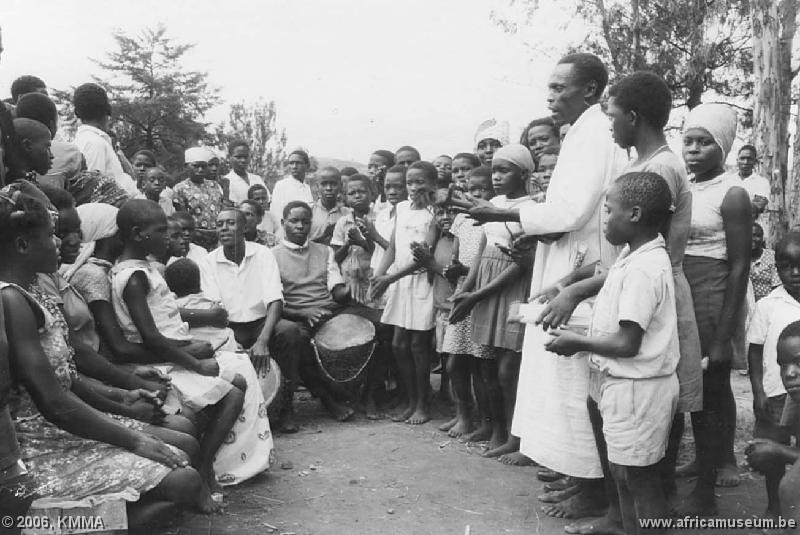
Epic poems, ebyevugo, are frequently performed during festivities and dancing parties
of the Hima, Iru, Kiga, and Hutu. The manner in which the Hima and the Iru perform theirebyevugo
deviates considerably from that of the Kiga
and the Hutu
.
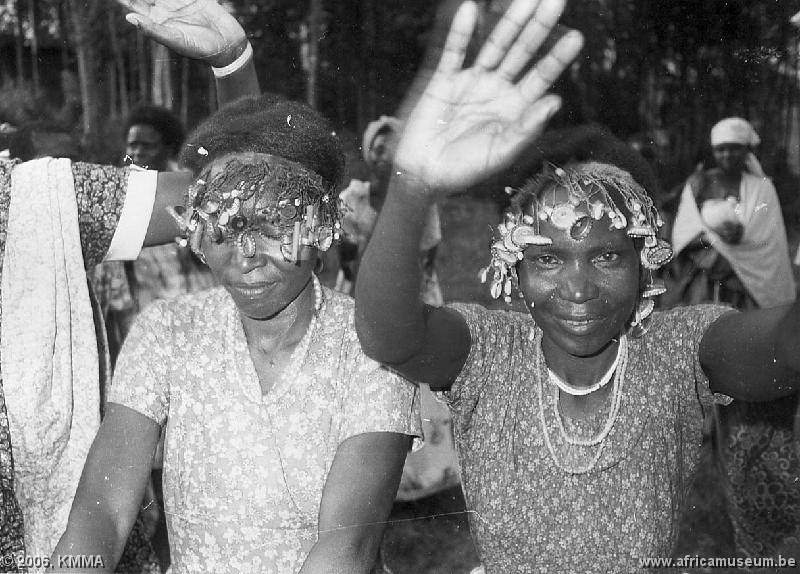
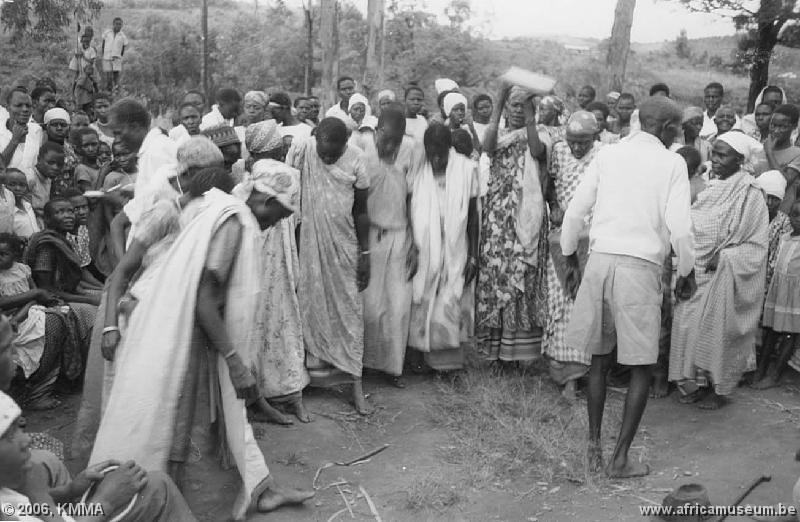
Each ethnic group has its specific dance for during public demonstrations and festivities.
These are group dances in which each dancer performs his individual rhythmic dance movements.
With the exception of, among others, the Hima entooro cercle dance, the usual Ankole
choreography does not strictly follow certain forms.
Today, most of the folk dances are mixed. There are, however, certain exceptions, such as
the entooro dance of the Hima men and the enjogyera of the Iru women from
the Buhweju chieftaincy.
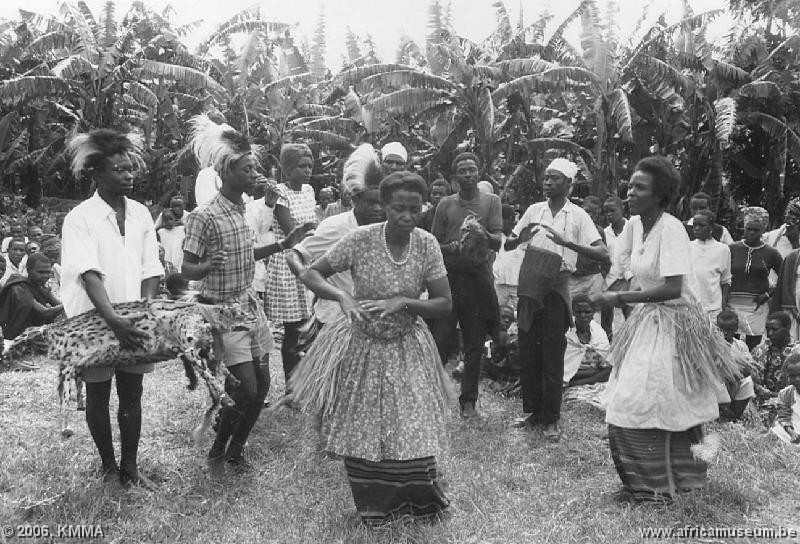
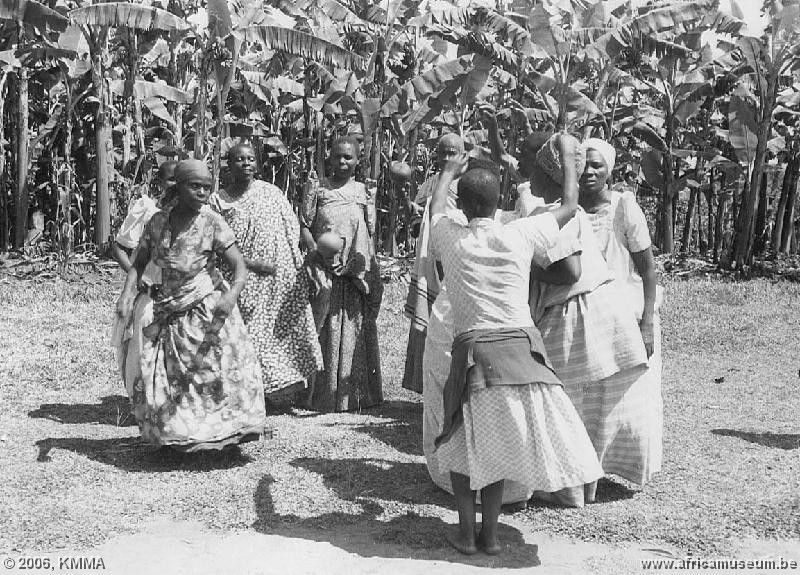
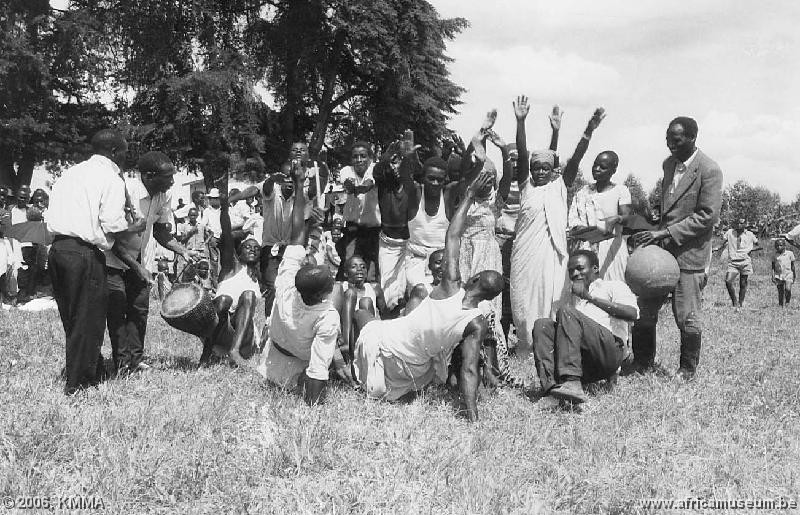
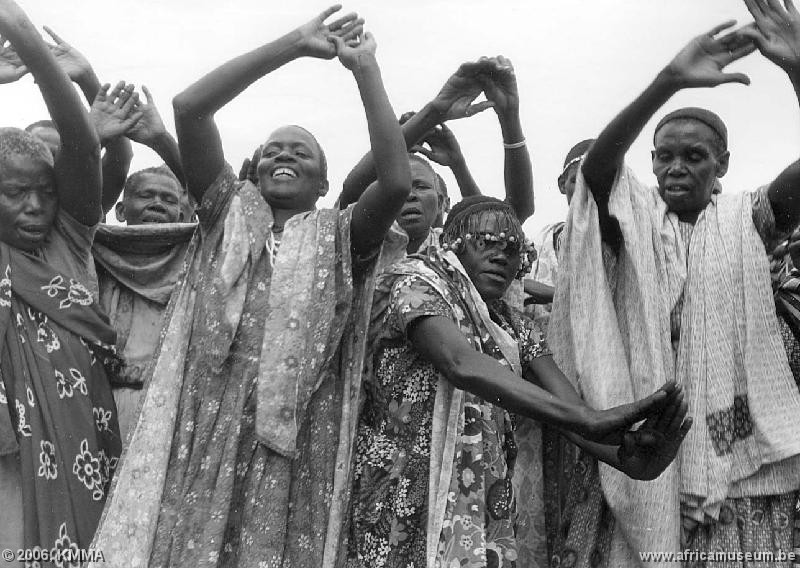
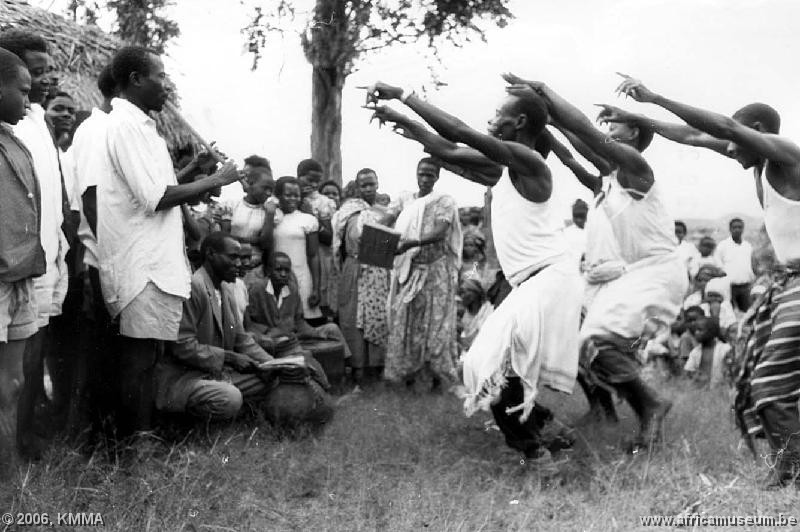
The ekitaaguriro is a traditional Iru dance, sung as a responsorial between solo
and choir. The solo singer's score, which in the ekitaaguriro dance usually contains
a voluble text, sometimes consists of a simple vocalize, while the men's choir score is entirely vocalized.
Unlike the dances of the other ethnic groups in Ankole, the ekitaaguriro is traditionally
struck up by the vocalists, both soloist and choir. The rhythm of the
engoma having sounded, the actual dance begins and the iron
amajugo ankle-bells are heard
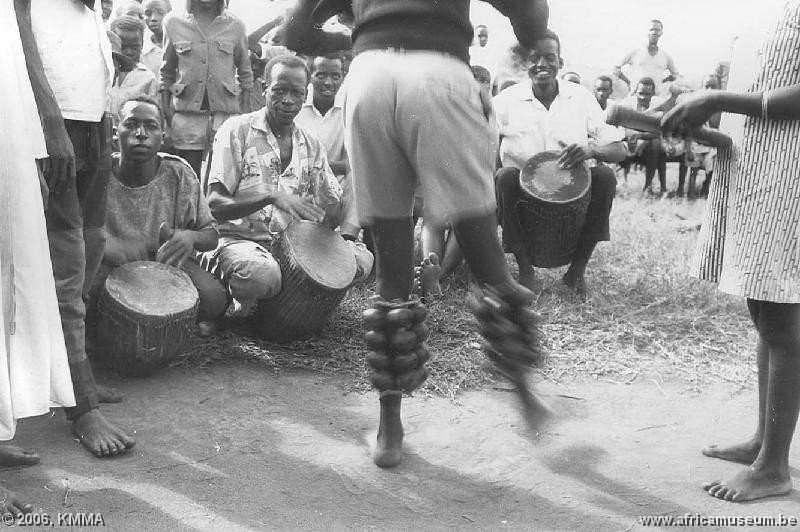
Contrasting with the dance music of the other African groups, the Hima herdsmen
in Ankole have no rhythmic musical instruments in the traditional entooro dance.
The melody prevails over the rhythm in their melismatic singing music, a feature
of which is the great variety of artificially performed microtones. While the tone
material of the main tones is predominantly pentatonic, the solo score differs from
the men's choir through its decorative notes.
Melody transposition also typifies the vocal music of the Hima. A special opening
melody of the soloist is heard not only at the beginning of the entooro dance song;
it introduces also the transposition of the tonal centre.
In contrast with the practice of the other inhabitants of Ankole, the Hima herdsmen
perform their traditional entooro in a circle seated on the ground, whilst
gracefully swinging their arms and upper bodies up and down.
Unlike the customary drum technique in Ankole, that is to say with one drumstick,
the Kunta play the engoma with their hands. The
rhythmic themes of the Kunta drums also differ from the regular drum strokes of,
say, the Iru and the Kiga.
The ekizina dance is generally started up by the drummers and not by the
vocalists as in the dance music of the Iru. Once the dance is well under way,
some variants can clearly be heard on various engoma,
each of which has its own pitch. A clear distinction can also be made between the
rhythmic variations of the enjebajeba leg rattles
and the amajugoamajugo ankle bells.
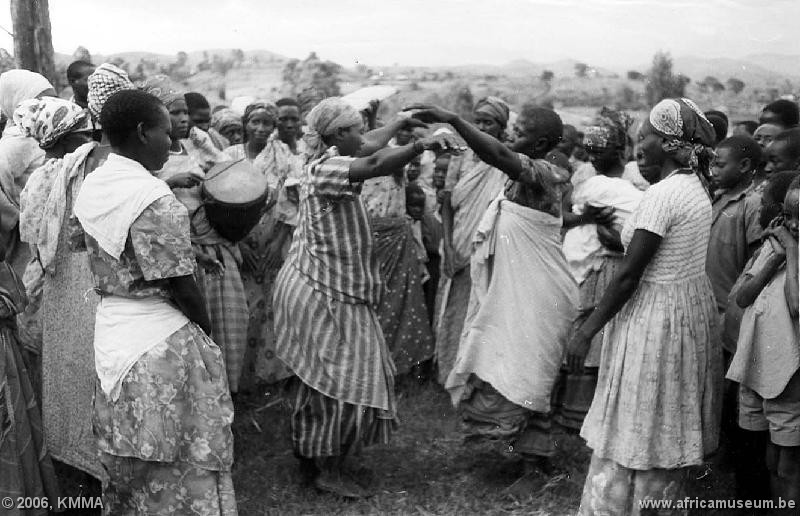
The raising of the tonal centre point is by no means the exception in the Kiga
dance songs. These transpositions can be raised up to a fourth. The Kiga usually
do not introduce the transposition with a special melodic pattern in contrast
with the performance technique of the Hima.
The ekizino dance is unthinkable without the rhythm of the flat cane case
rattle, in the same way as the dance music of the Iru, Kooki, and Kunta. The leg
rattles and the ankle bells, so popular in the dances of the Iru, Kooki, Kunta,
and Nyambo, are not worn by the Kiga dancers. Besides the rhythm of the
engoma and that of the case rattle, the Kiga also
produce rhythmic handclapping on frequent occasions.
In the Kiga dance music a contrast in dynamics is frequently brought about by the
sudden and unprepared alternation of peaceful passages with more vigorous parts in
which the drum rhythm is doubled and the regular handclapping replaced by a striking
rhythmic pattern. This stimulates the dancers to stamp with greater force on the
hard dance floor and increase the tempo.
This dance song's tone material is characterized by anhemitonic pentatonic.
The ekizaano dance songs of the Ziba are accompanied not only by the rhythm of the engoma, but also by the handclap rhythm and the enyimba gourd-drummer rhythm. The Ziba often use several drums, of very different pitch, in their dance music. A feature of the Ziba music is that two engoma are often struck by only one person with a stick in each hand. African informants say that the rhythm of the engoma and that of the gourd-drummer are based not so much on set patterns as on the impulse of the moment.
Epic songs are known to the Hima, Iru, Kiga, and Hutu. The variety of the performance technique is striking. In the first place, there is a big difference between the word material of the Kiga and Hutu epic poem and that of the Iru and Hima. Furthermore, in contrast with the practice of the Iru and Hima, the epic poem of the Kiga has an instrumental accompaniment, while that of the Hutu is varied with short intermittent songs or ebitongyerero. Special features of the Hima and Iru epic include the frequent use of titles of honour, the frequent repetition of the same ideas in different turns of speech and expressions, in addition to the specific vocabulary, rendering the heroic saga often difficult for outsiders to understand.
It is customary for the Kiga to interpret the epic poem with the instrumental accompaniment
of the ekinimba flute. The text often consists of fairly
short phrases or calls, while the instrumentalist produces uninterrupted stereotype melodic
themes of the ekinimba.
An interesting feature of the Kiga epic is that a high-pitched "aiiii" is added by a
woman to the recitation and flute accompaniment. In this way, she shows her approval and
expresses her joy. It quite often happens that the exponent of the Kiga epic arouses
hilarity among his audience.
Unlike the performance technique of the Kiga, the Hutu interpretation of the ekyevugo is alternated by short male voice passages, ebitongyerero. Several ebitongyerero with different melodies may be performed during one and the same epic. In a song, the tone material of the first ekitongyerero might be anhemitonic, whilst that of the second intermediate song differs through its hemitonic, which in Ankole occurs much less frequently. Glissandi in a falling line, which hitherto were not heard in the music of any other tribe in Ankole, here typify the final note of each intermediate song.
When Iru and Hima men perform epic poems, there is no question of alternation with
singing or with musical accompaniment as with the Kiga and Hutu. During the
rendering of the epic, the Iru and Hima soloist is assisted minimally by a few men
who, at the end of each sentence, merely show their approval with a short and powerful
"eeeh".
The virtuosity of the Iru and Hima epic poet is measured by the extent to which he
is able to render the longest possible sentences at the quickest possible pace and
without any pause for taking breath.
While in the past the ekyevugo was concerned not only with feats of arms or
cattle stealing but also personal heroism and warrior's courage, the epic of today
takes important political events as its source of inspiration, such as the
declaration of independence of Uganda in October 1962.
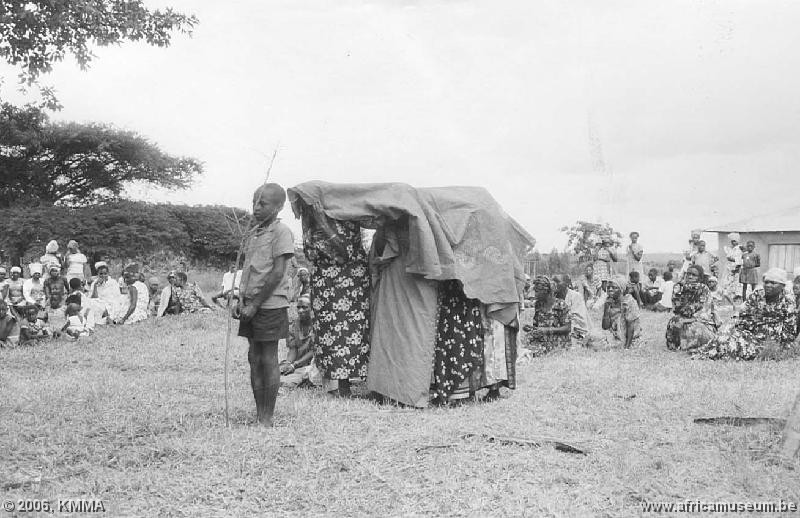
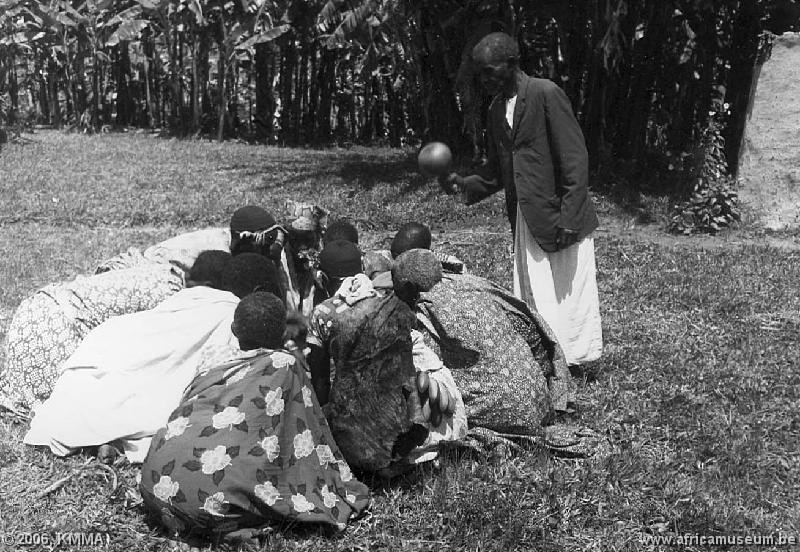
The importance of ritual music in Ankole should not be underestimated. All population
groups have their ceremonial music. Ritual songs in honour of the emandwa
spirits are performed on various occasions, such as the dedication of a family member
to the emandwa, during the consultation of magicians and medicine men, or
during sacrifices.
With the exception of the ritual music of the Hima, a feature of the emandwa
music of the other inhabitants of Ankole is a gourd-drummer who may only produce his
sounds during ceremonies in honour of the spirits.
The engoma is usually played in Ankole during the
emandwa music. The ritual music of the Hima, and sometimes also of the Nyambo,
forms an exception. In some of the ritual music of the Nyambo, only the rhythm of the
hand-drummer, enyimba, can be heard. This rhythm is
not produced by the usual gourd but by a small tin, perforated all around, and filled
with pebbles. Those present clap their hands.
The famous song, Ncerere ehiireyo, is usually sung at the opening of the
initiation ceremony in which a person is dedicated to the spirits.
 The ceremonial music of the Iru usually contains the sounds of the
engoma, a cane box rattle, leg rattles, ankle bells,
and also the oburengo, a small gourd rattle that is
not found in their folk music.
The ceremonial music of the Iru usually contains the sounds of the
engoma, a cane box rattle, leg rattles, ankle bells,
and also the oburengo, a small gourd rattle that is
not found in their folk music.
The frequent transposition of the melody is also a feature of this song. The drum
rhythms in the emandwa cult are usually not the same as those of their dance music.
The Igurire itaahe song, which the soloist introduces by the word "hurira"
in this rendering, often serves as opening song of the Iru initiation ceremony.
The yodel style of these emandwa songs contrasts sharply with the ritual song
music of the other ethnic groups in Ankole.
The incipit of these songs consists of what sounds like an alarm call to the spirits
performed by the soloist: "we-we-we", which after a short pause is followed by
a rolling of the "rrr". Then, after a short break, begins the actual song. The
extraordinarily long intervals of these songs are in very great contrast with the
fascinating microtones, which are such a special feature of the Hima music.
Gaining contact with the spirits at the beginning of the initiation is the aim of the song "Reeba, mandwa". The Hima women, sitting on the ground, sing entirely a capella, while holding the tip of their stylish clothes in their hands and waving their arms and upper body gracefully up and down. It is usually sung indoors before proceeding to the ceremonial place.
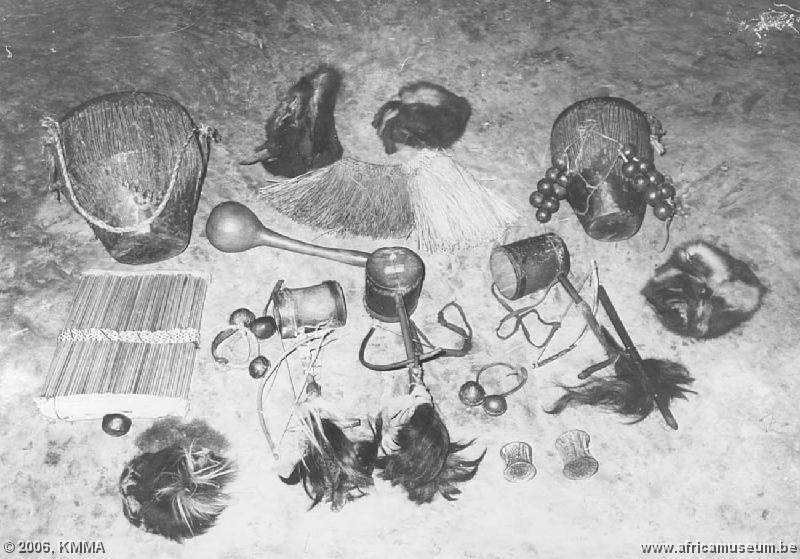
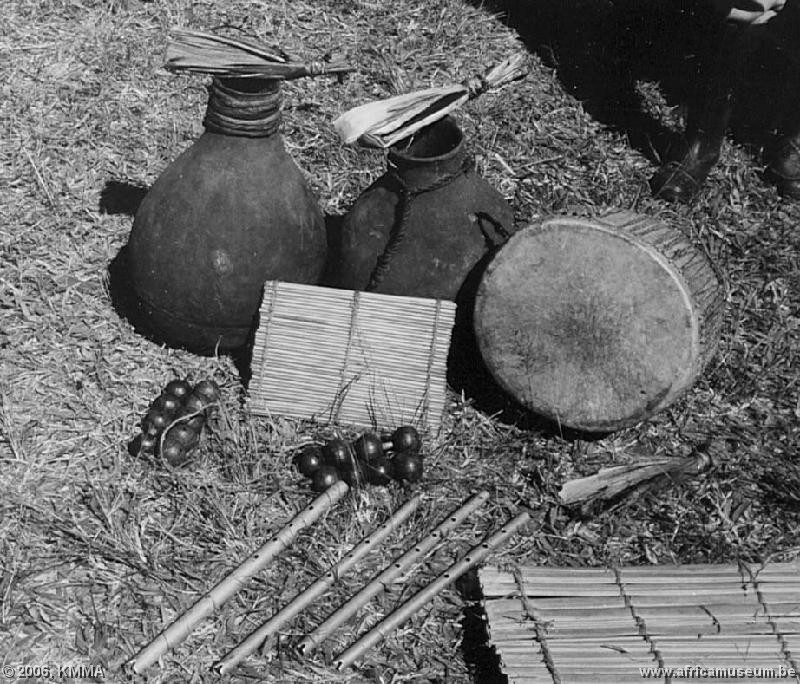
Given here is a summation of all musical instruments encountered in Ankole. There is a separate review for each instrument, enhanced by pictures and audio samples.
Most popular instruments: Engoma (drum), engalabi (drum), omubanda (flute), endingidi (fiddle), enanga (zither), rugaaniira (box rattle), enjebajeba (leg rattle), amayugo (ankle rattle), eijugo (bell), akajebajebe (rattle)
Very common instruments: Enyimba (rattle), amakondere (horn), enzamba (horn), enyungu (percussion pot), ensheegu (flute), esaasi (rattle)
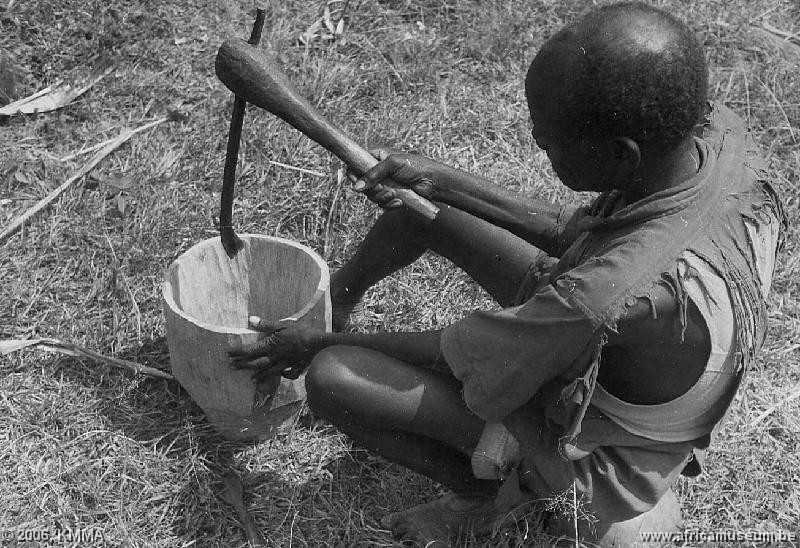
Less common instruments: Ekinimba (flute), ekidongo (musical bow), egobore (musical bow), omujariko (ground bow), entimbo (tube), enkyeka (pestle)
for more information see also: VAN THIEL, Paul, "Multi-Tribal Music of Ankole. An ethnomusicological study including a glossary of musical terms." Edited by the Royal Museum for Central Africa, Annales, Sciences Humaines, nr 91, 1977, 234 pp.
© KMMA/Paul VAN THIEL